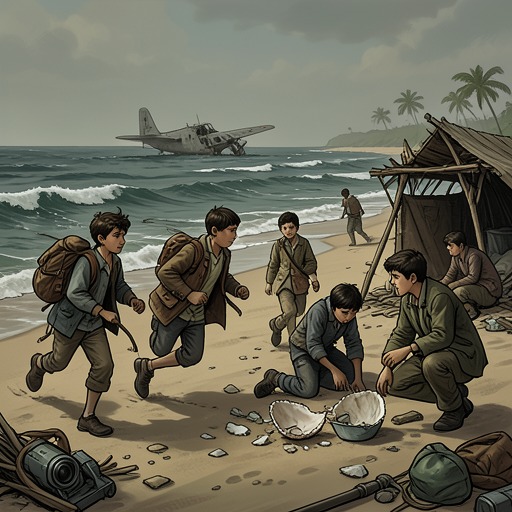
The meeting conch horn
Lord of the FliesThe meeting conch horn begins as a striking object in The lagoon and becomes the boys’ instrument for calling meetings and organizing who may speak. Its sound draws the scattered children together; its later role in their assemblies gives it a practical authority that depends on their willingness to respect shared rules. When that willingness breaks down, the horn remains recognizable and usable, but its power to secure order has sharply diminished.
Discovery and Physical Form
Ralph first notices something pale among the weeds in The lagoon. Piggy identifies it as a conch and explains that he has seen one on a wall, where its owner used it to call his mother. Ralph retrieves it with a palm sapling, pushing the shell across the weeds so Piggy can reach it. The action turns an object glimpsed at a distance into something the boys can handle and put to use.
The shell is deep cream, with fading pink around its mouth. It measures eighteen inches from its worn point, which has a small hole, to its pink lips; its body has a slight spiral and a delicate embossed pattern. Water runs down Ralph’s arm when he takes it from Piggy, and he shakes sand from its deep tube. These details make the horn more than an abstract emblem: its shape, opening, weight, and hollow interior are precisely what allow it to sound.
A Call Across the Island
Piggy proposes using the shell to call the other boys to a meeting. Ralph first blows without producing a clear note. After Piggy explains that the breath must come from lower down, Ralph works out how to force air through the instrument. The first successful blast booms beneath the palms, passes through The forest, and echoes back from The mountain. Birds rise from the treetops, while an animal squeals and runs in the undergrowth. The call makes its presence known across a landscape that had seemed quiet and empty.
Ralph blows again, producing a sharper, higher blare before his breath fails and the note sinks into a rush of air. He then sounds a series of short blasts. A child appears among the palms along the beach, and, as Ralph keeps blowing, voices from the forest draw nearer. The meeting horn thus works first as a practical signal: it converts Ralph’s breath into a sound that can reach people beyond sight and bring them toward The platform.
The first call also changes the object’s status for Ralph. At first he treats the shell as an interesting and pretty plaything, absorbed in the imagined island and dismissive of Piggy’s concerns. Once he manages to sound it, he becomes absorbed in the noise itself, continuing between bouts of laughter and taking pleasure in its force. Piggy, who proposed its use, helps establish the purpose that Ralph’s excitement initially overlooks. The same object joins the boys through both its novelty and its usefulness.
Assembly and the Rule of Speech
At the assembly, Ralph explains that the boys are on an uninhabited island, with no grown-ups to take care of them. To prevent everyone speaking at once, he proposes that the meeting horn be passed to the next speaker. Whoever holds it may speak without interruption, apart from Ralph’s stated right to intervene. The shell’s call has gathered the boys; possession of the shell now supplies a visible procedure for taking turns.
The procedure is immediately tested. Jack Merridew interrupts as Ralph is trying to explain it, but Piggy takes the horn, and the shouting subsides. Holding it, Piggy tells the assembly that he has been trying to draw attention to the question of who knows where the boys are. His intervention helps bring the meeting to the plane’s destruction and the possibility that rescue will not come soon. The horn does not simply mark a speaker: in this instance it gives Piggy a chance to make the group attend to a danger that excitement had obscured.
The arrangement nevertheless rests on consent rather than on any force inherent in the shell. During a later nighttime assembly, a dispute over ghosts brings Piggy and Jack Merridew into conflict over who has the horn. Ralph pushes between them and wrests it back, attempting to restore the meeting’s procedure. When the horn is taken from Ralph again, Piggy objects that he did not vote for ghosts. The rule can still be invoked, but the object no longer guarantees that it will be obeyed.
Authority Under Pressure
The later assembly makes the horn a measure of the boys’ failing order. Ralph says that speaking out of turn prevents proper assemblies, and he tries to conduct a vote on whether ghosts may exist. But Jack Merridew challenges the authority of Ralph’s election and rejects the importance of the rules. Ralph answers that the rules are all the boys have, while Jack Merridew insists on hunting and leads the gathering away into excited movement, mock hunting, laughter, and fear.
The contrast with the first call is decisive. Earlier, the horn’s note drew voices nearer through The forest, and its possession could quiet a meeting. Now Ralph considers sounding it to call the boys back, but fears that they may not return. Piggy urges him to do so, connecting the need for order with keeping the signal fire going and the hope of rescue. Ralph hesitates as the group gathers on the beach and chants. The horn remains in his hands, but its ability to summon cooperation has become uncertain.
The meeting horn therefore carries both a concrete function and a fragile social meaning. Its hollow shell amplifies a boy’s breath into a sound audible across the island; the same shell can pass from speaker to speaker and help make deliberation possible. Neither use is self-sustaining. The boys must answer the call and honor the speaking rule for the object to unite them. As their assemblies become disorderly and Jack Merridew openly dismisses the rules, the horn exposes the gap between possessing a sign of authority and having a community willing to accept it.